Why it’s okay for your gifted child to be bored during summer break
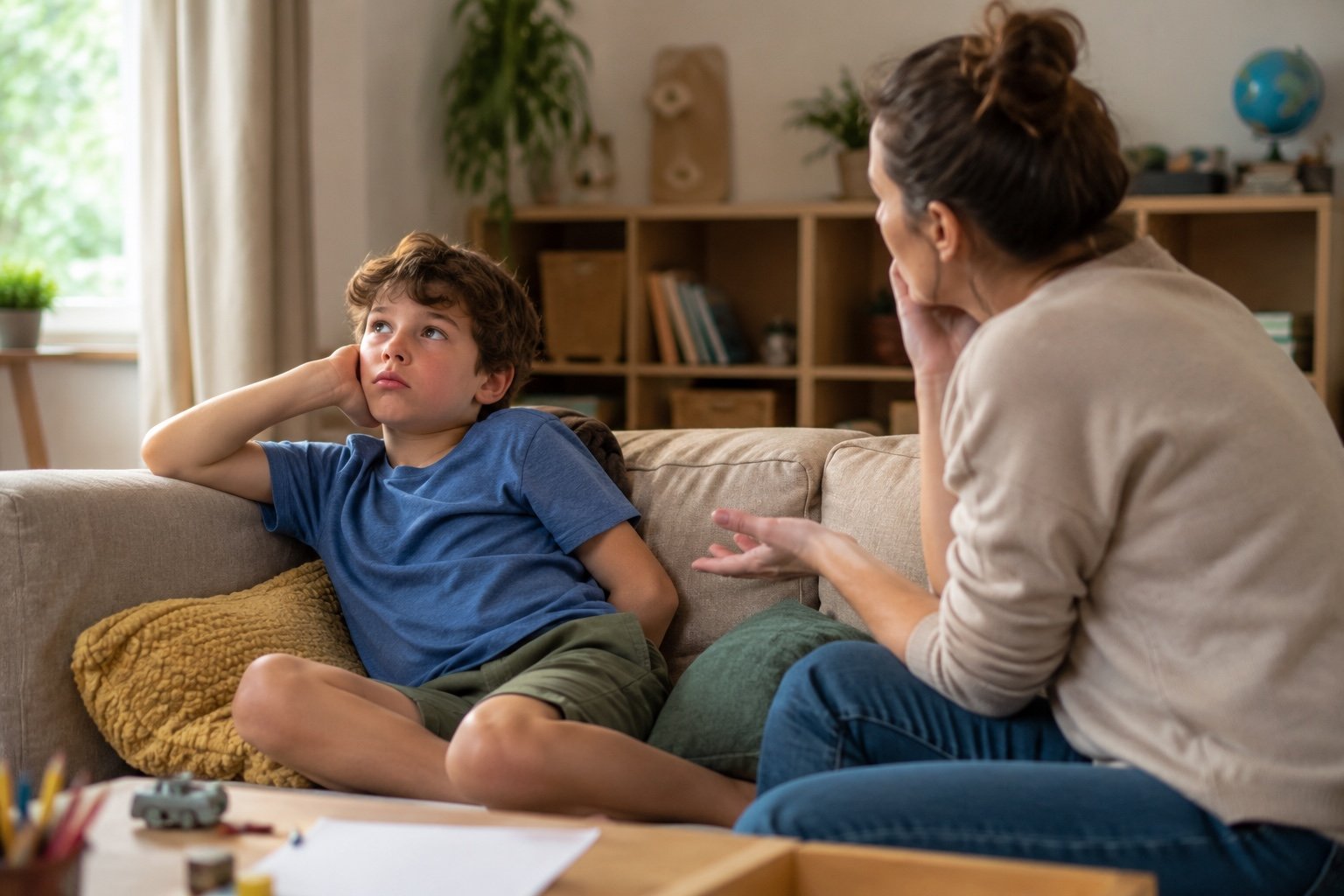
“Mom, I’m bored.”
Most parents have probably heard this one before. And often, the first thought that follows is: How do I keep my child from getting bored? The internet is full of lists of challenging activities, creative projects, and educational games, as if boredom were a problem that needed to be solved as quickly as possible. But maybe we’re asking the wrong question.
Instead of constantly trying to figure out how to keep our children entertained, it may be more useful to first ask what a child actually means when they say: “I’m bored.”
After a full school year, it’s okay to do nothing for a while
A school day involves much more than learning. Children follow instructions, switch between subjects and activities, take others into account, process social information, and constantly adjust their attention and behavior to what the situation requires. All of this draws on a range of cognitive processes, including executive functions¹. These skills help us direct our attention, inhibit impulses, hold information in mind, switch between tasks, and work toward a goal. Executive functions continue to develop throughout childhood and adolescence.
For some gifted children, the school day may also include times when the level or pace of instruction doesn’t match what they already know or can do. Research doesn’t show that gifted students as a group are simply bored more often than other students. What can differ, however, are the reasons for their boredom². For some cognitively advanced students, insufficient challenge and repetition of material they have already mastered can play a role.
That doesn’t mean that a child who shows little initiative during the first weeks of summer break necessarily “needs to recover from school.” There isn’t strong research evidence to support that specific conclusion. But it also doesn’t mean we need to fill that empty space immediately. After weeks in which much of the day has been structured by someone else, suddenly it’s okay to just… do what you want to do. And at first, that may feel surprisingly uncomfortable.
“I’m bored” doesn’t always mean the same thing
Boredom isn’t simply a lack of fun things to do. Researchers describe boredom, among other things, as a signal that we’re having difficulty engaging our attention in an activity that feels sufficiently meaningful or appropriate at that moment³. There can be many reasons for this. Something may be too easy, but it can also be too difficult. There may be too little stimulation, or a child may simply not know where they want to direct their attention. That makes “I’m bored” a much more interesting statement to hear during summer break. Because maybe not every kind of boredom needs the same response.
A mind full of ideas, but no idea where to start
Sometimes a child has no shortage of ideas. They want to build a fort, write a story, make a stop-motion movie, learn to code, or finally tackle that huge construction project they’ve been thinking about. But which one do you choose? Where do you start? And how do you turn a great idea into something you can actually do?
Executive functions play a role here, too. Planning, making choices, holding information in mind, and actually getting started are different processes from coming up with a good idea in the first place. Being cognitively advanced doesn’t automatically mean that organizing and getting started come easily. Executive functions also continue to develop throughout childhood and adolescence.
Sometimes, then, a child isn’t out of ideas at all. They are full of ideas, but don’t know how to move from thinking to doing. Read more about executive functions in cognitively advanced children.
Rediscovering what you actually want to do
There’s another kind of boredom I recognize at home. During the school year, a large part of a child’s day is already planned. Someone else decides where they need to be, what they need to do, and when they need to start or stop. During summer break, much of that structure suddenly disappears. And then a surprisingly difficult question may arise: “What do I actually feel like doing?”
It sounds simple. But deciding how to spend hours of unstructured time requires something different from following an existing schedule. At home, I notice how easily a screen can become the default choice in moments like these. Not necessarily because a child has consciously decided that gaming or watching videos is the thing they most want to do, but because a screen immediately offers possibilities. You don’t have to first figure out what you want to do.
That’s why I find it interesting to ask not only: How much screen time is acceptable? But also: What might happen if I don’t immediately fill this empty space for my child?
Boredom doesn’t have to be a problem
Boredom doesn’t feel good. That discomfort is an important part of what boredom is. Research describes boredom as a signal that what we’re doing at that moment isn’t sufficiently engaging our attention or doesn’t feel meaningful enough³. That unpleasant feeling can prompt us to do something else.
Maybe that’s also where the familiar idea that boredom is good for creativity comes from. And there is some evidence behind it. In some experiments, people who first completed a boring task later generated more ideas or more creative solutions than people who hadn’t been bored beforehand⁴. But the overall research picture is much less straightforward. A recent review found positive and negative associations, as well as studies that found no association at all⁵. So we can’t say that boredom automatically makes children more creative.
But that doesn’t mean we need to solve boredom immediately either. Because when a child says “I’m bored” and we instantly suggest an activity, we may also be taking over a question that they could gradually learn to answer for themselves:
What am I going to do with my time?
And that is exactly what I value about free time.
How can parents respond to boredom?
Instead of immediately offering a solution, you can first try to figure out what might be behind the boredom.
Does my child need some unstructured downtime?
Maybe nothing needs to happen. An afternoon spent hanging around isn’t a problem that needs to be solved.
Does my child have plenty of ideas but struggle to choose one or get started?
You can provide support without taking over the activity. Write down their ideas, sketch them out together, or help them identify one first step.
Does my child genuinely have no idea what they want to do?
That doesn’t need to be solved immediately either. You might ask: “Is there anything you’re curious about?”, “Is there something you’ve wanted to try for a long time?” or “What would help you get started?”
Does the boredom continue for a long time, and does the child seem to find little enjoyment or interest in anything?
That’s different from occasionally complaining that summer break is boring. Boredom isn’t always positive, and it doesn’t need to be deliberately prolonged.
The goal isn’t to make children experience as much boredom as possible. The goal is not to solve every moment of boredom for them immediately.
The return of curiosity
At The Curious Mind Expedition, curiosity is an important starting point for learning. But curiosity doesn’t emerge because an adult fills every empty moment with an activity. Sometimes a question appears unexpectedly. While building something. During a walk. While staring out the window. Or perhaps on an afternoon when you spent half an hour doing very little because you genuinely had no idea what you wanted to do.
That doesn’t mean boredom is necessary for curiosity. Nor can we say that boredom automatically makes children more creative, independent, or motivated. But we can sometimes give children the space to discover for themselves where they want to direct their attention. Maybe we don’t always need to hear “Mom, I’m bored” as a request for entertainment.
Sometimes our answer can simply be: “That’s okay. I’m curious to see what you come up with.” And then maybe we don’t need to do anything at all.
Want to read more about creating an environment where curious thinking has room to grow? Read How to encourage curious thinking: 10 practical tips for home and the classroom.
Scientific background
- Diamond, A. (2013). Executive functions. Annual Review of Psychology, 64, 135–168. https://doi.org/10.1146/annurev-psych-113011-143750
- Preckel, F., Götz, T., & Frenzel, A. C. (2010). Ability grouping of gifted students: Effects on academic self-concept and boredom. British Journal of Educational Psychology, 80(3), 451–472. https://doi.org/10.1348/000709909X480716
- Westgate, E. C., & Wilson, T. D. (2018). Boring thoughts and bored minds: The MAC model of boredom and cognitive engagement. Psychological Review, 125(5), 689–713. https://doi.org/10.1037/rev0000097
- Mann, S., & Cadman, R. (2014). Does being bored make us more creative? Creativity Research Journal, 26(2), 165–173. https://doi.org/10.1080/10400419.2014.901073
- Zeißig, A., Kansok-Dusche, J., Fischer, S. M., & Bilz, L. (2024). The association between boredom and creativity in educational contexts: A scoping review on research approaches and empirical findings. Review of Education, 12(1), e3470. https://doi.org/10.1002/rev3.3470

Ready to spark curiosity?
Wondering how to encourage curiosity without planning every minute of summer break? Download our free lesson. One surprising question or mind-bending optical illusion can be enough to ignite a child’s curiosity and start a new journey of discovery. Along the way, you’ll receive occasional inspiration, practical teaching ideas, and evidence-informed insights into gifted education, curiosity, and learning.