Why do children need to decompress after school?
Maybe we should not only ask how a child can calm down after school, but also what they need to recover from every single day.
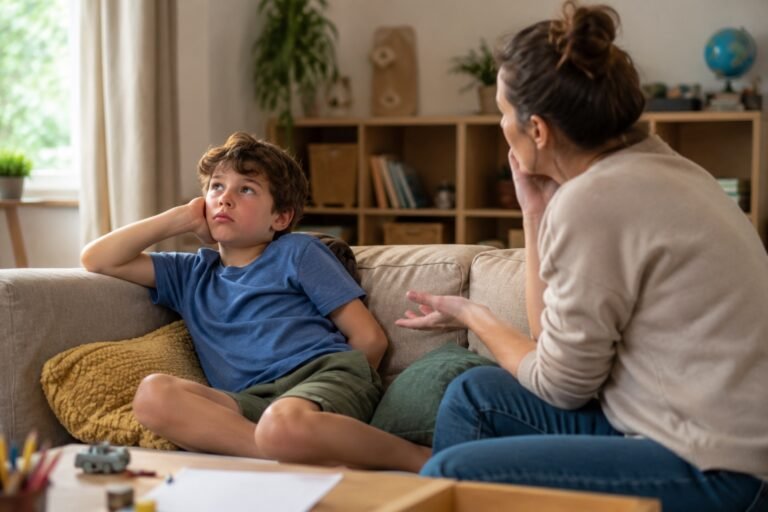
The first days of school have barely passed before the familiar stories start appearing again: children who come home irritable, burst into tears over something small, or need an hour before they can tolerate anyone around them. And then come the tips for helping children decompress after school. Time alone in their room. A weighted blanket. Movement. Fewer questions. A bin of sensory materials. A fidget toy in the classroom.
Many of those strategies can be helpful. A child who is overwhelmed does not benefit from a discussion about how we have designed our education system. In that moment, they may need calm, closeness, or simply some space.
But one question keeps nagging at me. Why do we talk so much about helping children decompress, and so little about the environment they apparently need to recover from every day?
A fidget toy does not reduce sensory input
The idea of decompressing suggests taking something away: less noise, less movement, less information. But a fidget toy actually does something different. It adds another stimulus. Only this one is predictable and under the child’s control. That can feel very different. Voices, scraping chairs, and unexpected touches happen around a child. Squeezing, spinning, or fiddling with an object is something they can control themselves.
For some children, that kind of controlled movement may feel helpful or make it easier to stay engaged with a task. For others, it becomes one more distraction. Research on fidget devices does not show a consistent positive effect that applies to every child.¹ The problem is not that a child is offered a fidget toy. The problem begins when the tool replaces the conversation about the conditions that made it necessary in the first place.
How inevitable is our school environment, really?
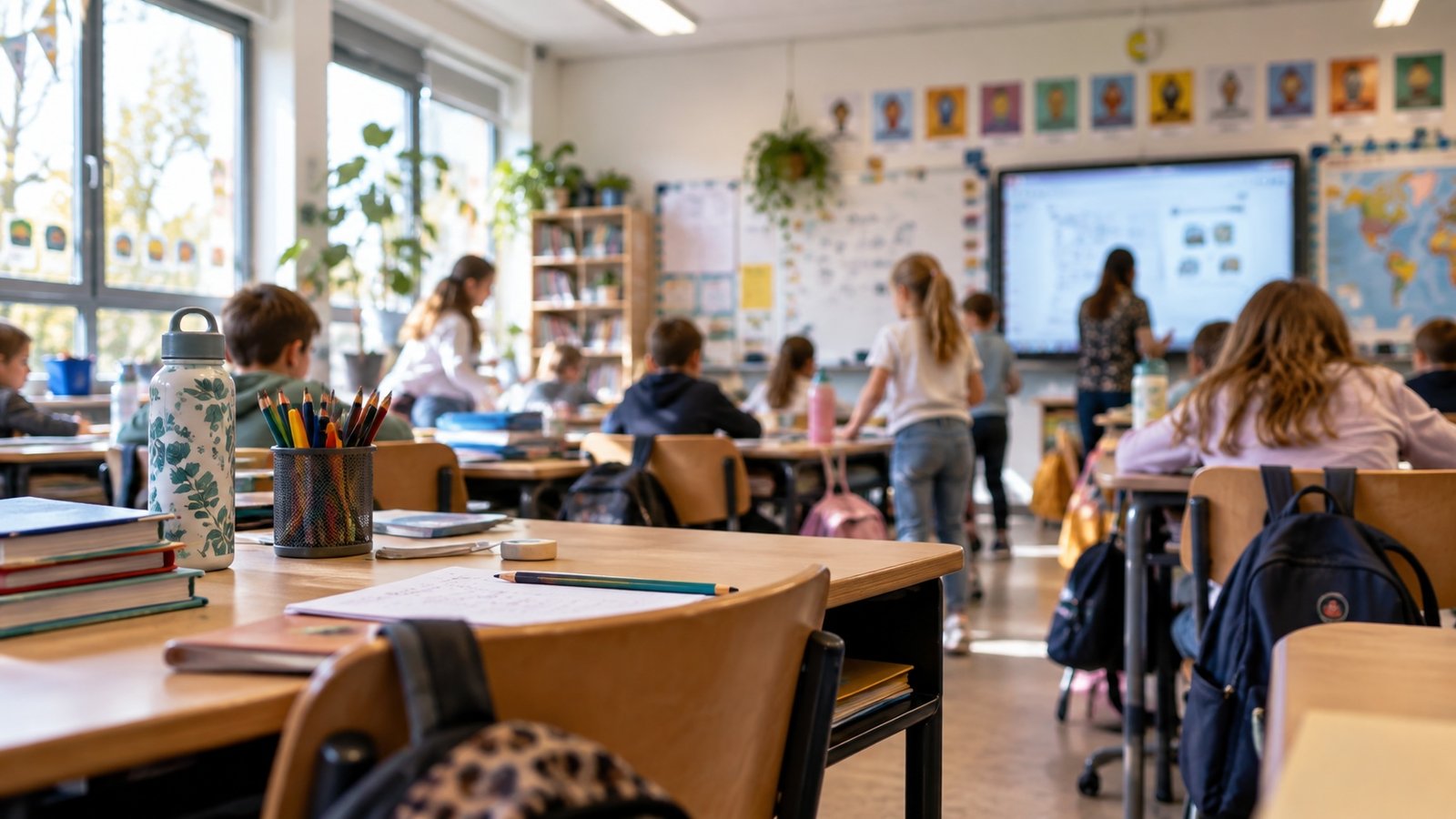
Imagine an ordinary school day from the perspective of a child’s attention. A classroom full of moving children. Several conversations at once. Chairs scraping across the floor. Bright lights. Displays covering the walls. A digital board constantly changing. Instructions that need to be processed while someone nearby drops a pencil case. Transitions from math to reading, from classroom to hallway, from quiet work to collaboration. A busy playground. Then back inside, switch gears, and continue.
Of course, school does not need to be a stimulus-free environment. Children learn, play, and develop in relationship with other people. But that does not mean the way we have organized those interactions at school is inevitable.
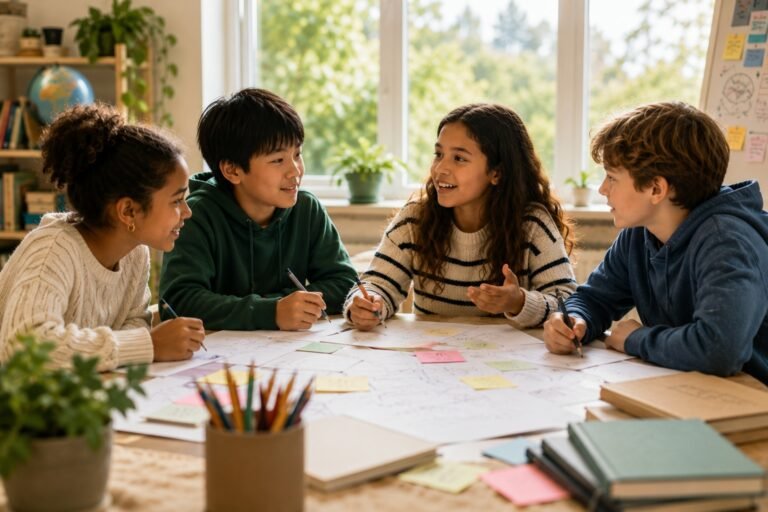
Many children spend a large part of their day in a group of roughly the same age, in the same school environment, following a schedule that is largely determined for the whole group. That is one way to organize learning, but it is not the only one.
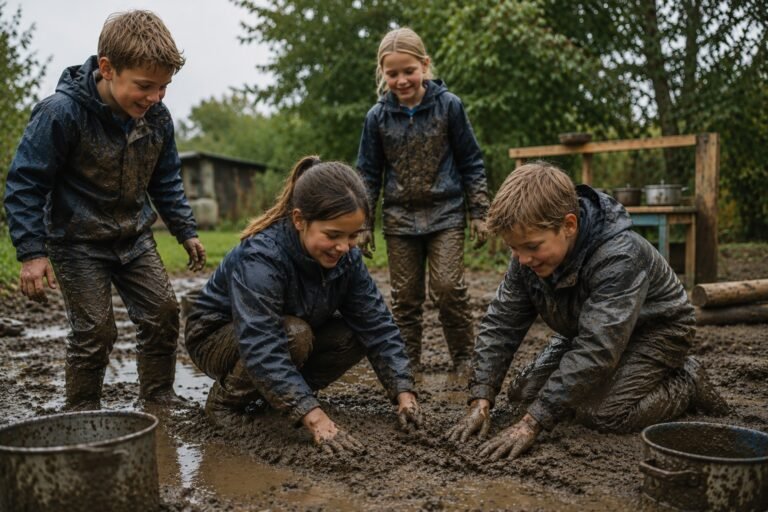
Research with contemporary hunter-gatherer communities, for example, shows children learning extensively through observation, participation, and play. Not only from adults, but also from other children, including children of different ages.² That does not tell us how children are “naturally” supposed to learn. Nor does it mean that school is somehow unnatural or wrong. What it does show is that our current way of organizing school is not an inevitable feature of human learning. Learning and playing together are deeply human. How we organize them is a choice.
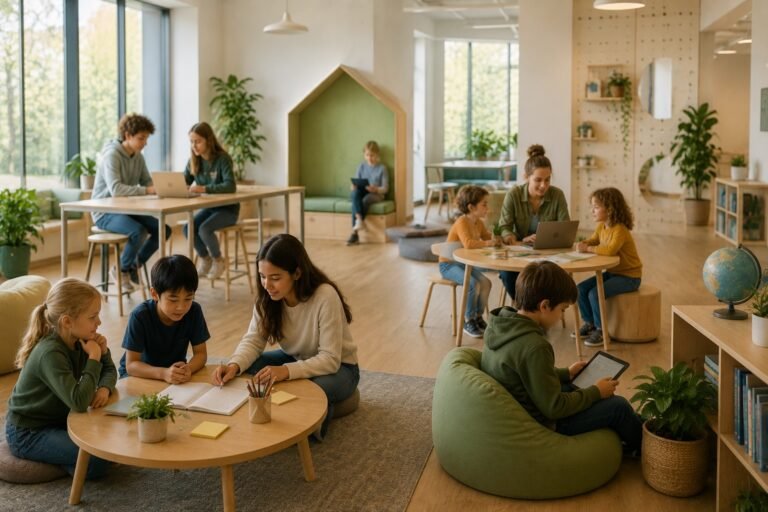
The same is true of the amount of stimulation built into a school day. How predictable that stimulation is, how large the group is, how a classroom is arranged, how often children have to switch activities, and whether they can step away for a moment are not laws of nature. They are choices. Research on classroom noise has long shown that noise and reverberation can make speech perception and several cognitive tasks more difficult. Children also appear to be more vulnerable to the effects of noise than adults.³ Yet we can easily start treating a busy, noisy classroom as a fixed reality that every child simply needs to learn to tolerate. And when that does not work, we give the child a tool.
The message can quietly shift from this environment is asking a lot of you to you need to get better at coping with it.
Can children actually decompress during the school day?
It is worth looking at the structure of the school day itself. We call certain parts of the day breaks, but that does not necessarily mean they provide a real break from stimulation.
Lunch may still mean sitting in a busy space surrounded by other children, conversations, movement, and noise. Recess can be valuable and restorative, but it can also be highly social, active, and stimulating. And as soon as it ends, children are expected to transition back inside, shift their attention, and continue with the academic day.
So perhaps the more useful question is not simply whether children have breaks, but whether those breaks actually give them a chance to step away from the demands of the school day.
Play matters. Movement matters. Connecting with other children matters too. But perhaps a full school day also needs space for something that is easily lost: a few moments of not listening, not responding, not performing, and not constantly being surrounded by a group.
Too much and too little at the same time
For gifted learners, there is another layer worth considering. Overstimulation in gifted children is sometimes quickly attributed to sensitivity. But perhaps we should look not only at how much a child notices. We can also look at what the environment demands from that child, and how much attention the schoolwork itself actually requires. A school day can ask a great deal and very little at the same time. A great deal of attention goes into waiting, switching gears, listening, collaborating, filtering out background noise, and adjusting to the pace of the group. Cognitively, however, the work may sometimes ask very little.
Research on gifted underachievement identifies factors such as boredom, insufficient challenge, and a curriculum that does not adequately match the learner’s needs.⁴ At the same time, research on selective attention suggests that irrelevant stimuli may sometimes have less impact when our attention is strongly engaged by a relevant task.⁵ That raises an interesting question: what happens when a child is sitting in a highly stimulating environment while the work itself barely requires their attention?
A child can be bored during instruction and still hear every conversation at the table next to them. They may be able to complete the assignment almost automatically, with very little effort needed to stay on task, while constantly noticing sounds, movements, and events around them. When a task genuinely requires engagement, attention may be drawn much more strongly toward the activity itself. That does not mean that more challenging work automatically prevents overstimulation or sensory overload. Nor has it been shown that gifted children necessarily become more sensitive to environmental stimuli when they are underchallenged. But it does suggest that cognitive challenge and environmental stimulation do not always need to be treated as completely separate issues.
This can create a striking combination: too much of what drains energy and too little of what truly captures attention. Headphones may reduce noise, but they do not make an overly simple task more challenging. Enrichment can increase cognitive engagement, but it does not make a noisy classroom quieter. So perhaps the more useful question is not only: how can we help this child decompress? It is also: how well does the overall learning environment fit this child, in both stimulation and challenge?
Adults look for space too
For adults, we consider this perfectly normal. After an intense day, we may look for quiet. We put on headphones so we can concentrate. Close a door. Step outside during lunch. After a demanding workday, we may need some time to ourselves before we have the capacity to engage with other people again. In doing so, we acknowledge something very ordinary: attention and social availability are not unlimited resources.
So why do we focus so heavily on teaching children to regulate themselves better? Maybe we have created environments that consistently demand a great deal of attention, and then focused primarily on finding tools that help the individual keep functioning within them.
Treat overstimulation as information
This does not mean every fidget toy should disappear from the classroom. Headphones, opportunities to move, a quiet place to work, or another support may be exactly what a child needs. But it does mean we do not have to view overstimulation solely as something happening inside the child. A child who needs to recover from school every day is giving us information. That is not automatic proof that the entire school day is wrong, but it is a signal worth investigating. We can start asking different questions:
- Which stimuli are necessary for learning, and which are mainly a result of how we have structured the day?
- Can a child choose a quiet place to work without that choice feeling like an exception or a reward?
- Is the classroom visually and acoustically manageable?
- Are all of the transitions between activities really necessary?
- Is a break truly a break, or does only the activity change?
- Do we build moments of calm into the school day instead of pushing all of the recovery time into the hours after school?
- Does the level of cognitive challenge fit the child—not just the amount of sensory input?
- Do we look for patterns: when does it go well, when does the child become overwhelmed, and what is different in those moments?
These questions will not allow us to prevent every stimulus. Nor should they. Curiosity, music, play, lively conversation, movement, and laughter can all be energizing. Children do not need to be protected from every sound, every demand, or every social interaction. But there is a great deal of room between a stimulus-free environment and one in which a child is constantly required to adapt.
Not just learning to tolerate it
Self-regulation matters. Children can learn to notice what is happening in their bodies, recognize what stress or overload feels like, and understand what helps them return to a calmer state. That gives them language, insight, and options for responding. But self-regulation should not become a polite way of saying: learn to tolerate this environment, because we have no intention of changing it.
A fidget toy can help. A quiet space can help. Decompressing after school may be necessary. We should not take those supports away from children who benefit from them. But we should also keep asking the more uncomfortable question:
Why do we so often ask children to recover from an environment they have to return to and function in all over again the next morning?
School as we know it is not a law of nature. Neither is the way we group children, structure the school day, design classrooms, or organize breaks. These are all choices made by adults. That does not mean those choices are wrong.
It does mean we are allowed to examine them.
Maybe real decompression does not begin with one more product placed in a child’s hands, but with adults who are willing to look critically at what they have organized around that child.
References
- Schoenen, E. C., Alsip, B. S., Martinez, J. C., Grekov, P., Aspiranti, K. B., & Hulac, D. M. (2025). A meta-analysis of fidget devices as academic and behavioral interventions. School Psychology Review, 54(3), 315–327. https://doi.org/10.1080/2372966X.2024.2411576
- Lew-Levy, S., Reckin, R., Lavi, N., Cristóbal-Azkarate, J., & Ellis-Davies, K. (2017). How do hunter-gatherer children learn subsistence skills? A meta-ethnographic review. Human Nature, 28, 367–394. https://doi.org/10.1007/s12110-017-9302-2
- Klatte, M., Bergström, K., & Lachmann, T. (2013). Does noise affect learning? A short review on noise effects on cognitive performance in children. Frontiers in Psychology, 4, 578. https://doi.org/10.3389/fpsyg.2013.00578
- Rongen, F. C., Dijkstra, S. C., Hupkens, T. H., Vingerhoeds, M. H., Seidell, J. C., & van Kleef, E. (2023). A qualitative study exploring the perceptions of children, parents and school staff towards the development and implementation of school lunch provision within primary schools in the Netherlands. BMC Public Health, 23, 2367. https://doi.org/10.1186/s12889-023-17265-4
- Raoof, K., Shokri, O., Fathabadi, J., & Panaghi, L. (2024). Unpacking the underachievement of gifted students: A systematic review of internal and external factors. Heliyon, 10(17), e36908. https://doi.org/10.1016/j.heliyon.2024.e36908
- Lavie, N., Hirst, A., de Fockert, J. W., & Viding, E. (2004). Load theory of selective attention and cognitive control. Journal of Experimental Psychology: General, 133(3), 339–354. https://doi.org/10.1037/0096-3445.133.3.339