
Why gifted children need to learn how to think, not just know the answers
The world is changing. What does that mean for education?
Children are growing up in a world where information is almost always within reach. With a smartphone, they can look up information about nearly any topic in seconds. And with the rapid development of artificial intelligence, technology can do much more than retrieve information: it can write, summarize, create images, generate code, and explain complex ideas. For gifted children, this raises an interesting educational question: What do they need to learn when finding an answer is becoming increasingly easy?
This does not make knowledge obsolete. Quite the opposite. To evaluate information, recognize connections, or use AI effectively, you need to know something about the subject yourself. Without sufficient knowledge, it is difficult to recognize whether an answer is logical, complete, misleading, or simply wrong.
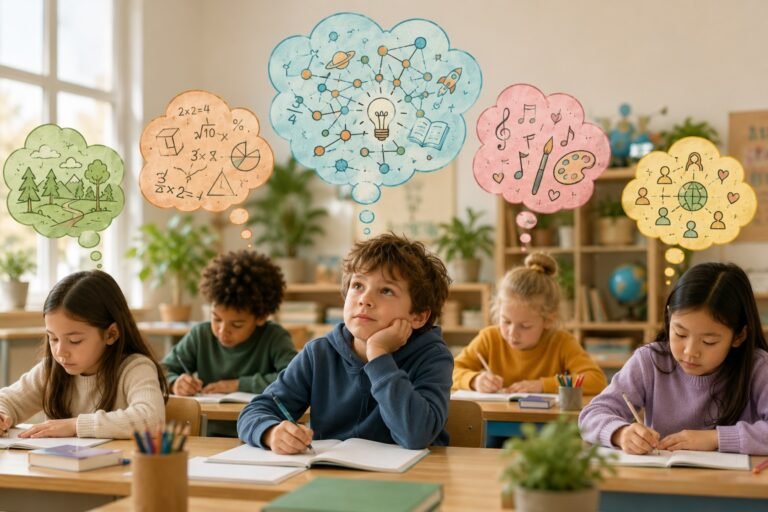
But knowledge alone is not enough. Children also need to learn what to do with what they know. They need opportunities to analyze, ask questions, evaluate information, weigh arguments, explore possibilities, and examine their own thinking. So the question for education is not:
Do children still need to acquire knowledge when information is available everywhere?
A better question is:
How do we teach children to use knowledge to think independently?
AI can generate answers. But which answer do you need?
Anyone who uses AI quickly discovers how much the question can influence the response. Compare:
“Tell me about climate change.”
with:
“How could climate change affect food production over the next twenty years, and what uncertainties should we consider when evaluating those effects?”
The second question invites a much more focused response. Not because the technology has suddenly become more capable, but because the person asking the question has first considered what they actually want to understand.
AI can generate questions too, of course. The distinction between people and technology is therefore not simply that AI provides answers while humans ask questions. The more interesting challenge lies elsewhere. Which question matters? What information is missing? What assumptions are hidden in an answer? Which sources are trustworthy? Does the reasoning hold up? And what should you investigate next? As technology becomes increasingly capable of producing convincing responses, children need to learn that a convincing answer is not necessarily a good answer.
What do children need in a changing world?
We cannot know exactly what the world in which today’s children will eventually work will look like. Technology is changing the nature of work, creating new possibilities, and reshaping existing professions. Future-focused education therefore cannot be limited to transferring knowledge. Children also need opportunities to learn how to:
- evaluate information critically;
- investigate complex problems;
- compare different perspectives;
- generate creative possibilities;
- recognize meaningful connections;
- collaborate with others;
- justify their choices;
- adjust their approach;
- and continue learning when circumstances change.
These are sometimes described as 21st-century skills. But underneath that label lies something much more fundamental: learning what to do when the answer is not immediately clear.
Knowledge is essential for deeper thinking
Discussions about education sometimes create an artificial choice between knowledge and thinking skills. I do not find that distinction particularly useful. It is difficult to think critically about climate change without understanding what climate is. You cannot evaluate historical sources well without historical knowledge. And it is difficult to check an AI-generated response when you do not know enough about the subject to recognize errors, weak reasoning, or unlikely claims. Knowledge gives children something to think with.
The next step is learning how to use that knowledge: recognizing connections, evaluating arguments, comparing information from different sources, developing hypotheses, generating possible solutions, and examining their own reasoning. Knowledge is not the opposite of thinking. Knowledge makes richer thinking possible.
What does this mean for gifted children?
This question is particularly relevant in gifted education. Not because all gifted children think in the same way or are automatically curious, creative, or inquiry-driven. Gifted learners are a diverse group. However, some cognitively advanced students understand particular material quickly or have already mastered learning objectives before extensive instruction and practice are provided. When that happens, an important question emerges:
What do we do with the learning time that can become available?
Giving a student more practice with something they have already mastered does not automatically lead to more learning. That time can instead create opportunities for tasks in which the answer is not predetermined. Students can investigate questions that require them to gather and evaluate information, work on problems with multiple possible solutions, or examine an issue from different perspectives. Not simply more work, but work in which there is something new to learn.
Finding the right answer is not the same as learning how to think
Many school assignments have a clear endpoint: there is a correct answer. Those assignments absolutely have a purpose. Children need foundational knowledge and skills, including mathematics, literacy, and subject-specific knowledge. But if students primarily encounter tasks in which the path to the solution is already known and the answer has already been determined, they have fewer opportunities to practice other forms of thinking. Learning how to think also requires questions such as:
Which solution would work best, and why?
What information do you still need before you can draw a conclusion?
Can you develop a counterargument to your own position?
What would change if one of the conditions were different?
How do you know this source is trustworthy?
The goal is no longer simply to arrive at the correct answer. The thinking process itself becomes part of what the student is learning.
Learning how to think takes practice
Critical thinking, problem-solving, and reflection do not develop simply because we tell children to “think more deeply.”
Children need situations in which they actually have to use these skills. They need experiences in which they do not immediately know what to do, have to investigate a question, and must decide on an approach themselves. Sometimes an initial idea will not work. They may need to revise it, compare different solutions, or defend their reasoning.
Making mistakes matters too. When students discover that their reasoning does not hold up, receive feedback, or reflect on the approach they chose, they have an opportunity not only to learn something, but also to learn about how they think and learn. Research on critical-thinking instruction shows that thinking skills can be developed and that how they are taught matters.¹ That means thinking skills are not an optional extra for students who finish their regular work early. They are part of education. And just like other forms of learning, developing them may require instruction, feedback, questioning, and guidance from a teacher.
Enrichment can create space for deeper thinking
This is, in my view, one of the important purposes of high-quality enrichment. When a student has already mastered particular grade-level learning objectives, unnecessary instruction and repetition can be reduced. This creates room for different learning experiences. That does not mean every gifted student needs the same enrichment. Appropriate education remains responsive to the individual learner. But meaningful enrichment can give students opportunities to do something that routine work often requires much less of: figuring out what to do when they do not already know the answer.
Students might investigate a phenomenon, design something, examine a problem from multiple perspectives, test a hypothesis, or compare possible solutions. The teacher’s role is not simply to hand the student a harder worksheet and expect them to continue independently. Enrichment is still education. When a task is genuinely challenging, a student may need instruction, questions, feedback, or guidance to move forward. That is what turns enrichment from something that merely keeps early finishers busy into an opportunity for genuine learning. I explored this idea further in Gifted Children Don’t Need More Work. They Need Different Work.
Curiosity does not begin with the answer
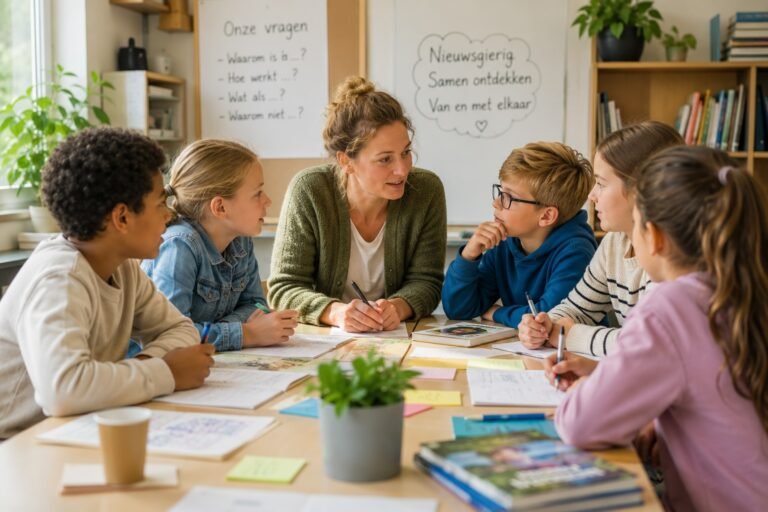
At The Curious Mind Expedition, curiosity plays a central role in how we think about learning. Not because every gifted child is constantly curious. And not because curiosity automatically results in meaningful learning. But a good question can open something up.
Why does this happen?
How do we actually know that?
What would happen if…?
Could it work another way?
Which explanation best fits the evidence?
A question like that creates room to build knowledge, explore ideas, make mistakes, evaluate information, and eventually perhaps arrive at an answer. And often, that answer leads to another question. That is fundamentally different from education that focuses primarily on reaching an answer that was already known before the learning began.
Education in the age of AI
The rise of AI does not, in my view, make knowledge less important. If anything, AI may make it even clearer why knowledge and thinking are both essential.
Technology can find, combine, and generate increasing amounts of information. That makes it even more important for children to understand the subjects they are exploring, formulate relevant questions, evaluate information, consider different perspectives, and recognize when a convincing answer is still incomplete or flawed. Then AI can become a tool without children outsourcing their own thinking to it.
That, to me, is a much more interesting goal for education. We cannot prepare children for one specific future when no one knows exactly what that future will look like. But we can help them build knowledge and learn how to use it. To remain curious when an answer is easy to find. To remain critical when an answer sounds convincing. And to keep asking questions when the first answer is not enough. Perhaps that is one of the most important things we can give children:
not just the ability to know the answers, but the ability to figure out what to do when they do not know the answer yet.
References
- Abrami, P. C., Bernard, R. M., Borokhovski, E., Waddington, D. I., Wade, C. A., & Persson, T. (2015). Strategies for Teaching Students to Think Critically: A Meta-Analysis. Review of Educational Research, 85(2), 275–314.
- OECD. Future of Education and Skills 2030 / OECD Learning Compass 2030.
- OECD & European Commission. AI Literacy Framework for Primary and Secondary Education.
- Reis, S. M., Westberg, K. L., Kulikowich, J. M., & Purcell, J. H. (1998). Curriculum Compacting and Achievement Test Scores: What Does the Research Say? Gifted Child Quarterly, 42(2), 123–129.
The world is changing! Let’s teach children how to think.
In a world where AI can generate answers in seconds, the ability to ask thoughtful questions, think critically, and solve problems creatively has never been more important.
Help children develop curiosity, inquiry skills, and confident problem-solving with a free lesson from The Curious Mind Expedition. You’ll also receive occasional inspiration, practical teaching ideas, and new insights into gifted education.



One Comment