
Gifted children don’t need more work. They need different work.
Why more of the same doesn’t lead to more growth
When a gifted child finishes classroom work before the rest of the class, teachers often look for a practical solution. That’s completely understandable. Teachers are responsible for an entire class and also need to make time for students who require additional instruction or support.
As a result, students who finish early are often given an extra worksheet, a more difficult math problem, or a separate puzzle book. This keeps them occupied while the rest of the class continues working. But being busy is not the same as learning.
Many gifted children don’t need more work. Additional practice of material they have already mastered rarely leads to new learning. Assignments without a clear learning goal seldom increase motivation. Instead, they often lead to boredom, frustration and the feeling that working quickly is being punished.
Gifted children often learn more quickly
Many gifted children need less instruction and repetition to achieve particular learning objectives. This does not mean that every gifted student learns equally quickly in every subject. A student may already have mastered certain material while still needing instruction and practice in other areas.
That doesn’t mean everything comes naturally to them. Gifted children also need to acquire new knowledge and develop new skills. The difference lies mainly in the pace at which they master new learning.
When a student has already achieved the learning objectives, additional practice provides little educational benefit. Yet the extra time is often filled with more of the same: extra math problems, additional language exercises or separate classroom activities simply to keep students occupied. This means an important opportunity is being missed.
Curriculum compacting: creating room for growth
An important strategy in gifted education is curriculum compacting.
With curriculum compacting, unnecessary repetition is removed while the essential learning objectives remain in place. A student demonstrates mastery of the material and no longer needs to complete every practice exercise. Research on curriculum compacting has shown that a substantial amount of the regular curriculum can be eliminated for students who have already mastered the material without negatively affecting their achievement.¹
Curriculum compacting is not about learning less. It is about creating time for new challenges. When gifted students no longer have to spend unnecessary time repeating material they have already mastered, there is room for learning experiences that better match their developmental needs.
Acceleration when it’s needed
In some cases, curriculum compacting alone is not enough.
A student may not only master the curriculum more quickly but may also be ready for material from a higher grade level. In these situations, acceleration can be an appropriate educational strategy.
Acceleration can take different forms. It may involve studying a subject at a higher grade level, moving through the curriculum at a faster pace or in some cases even skipping an entire grade.
The purpose of acceleration is not to move a child through school as quickly as possible. The goal is to provide education that matches the level at which the student is ready to learn and think. Research on acceleration for high-ability learners has found positive academic effects on average. A meta-analysis also found no evidence that acceleration, on average, comes at the expense of students’ social-emotional development.²
Acceleration therefore requires an individualized approach. Decisions should consider not only the student’s mastery of the curriculum, but also their individual needs and characteristics and the educational context.
Enrichment: where real growth happens
Curriculum compacting creates time. Acceleration and/or enrichment then determine how that time is used.
Effective enrichment goes beyond simply giving more difficult assignments. It involves different ways of thinking, investigating, creating, and learning. Within gifted education, a distinction is often made between depth enrichment and breadth enrichment.
Depth enrichment
With depth enrichment, students explore a topic in greater depth. The focus is on critical thinking, analyzing, investigating, and making complex connections. This might for example include formulating research questions, exploring philosophical questions, or solving complex problems.
Breadth enrichment
With breadth enrichment, students explore new areas of knowledge beyond the regular curriculum. Alongside their regular schoolwork, they may learn about history, science and technology, global citizenship, an additional language, or arts and culture.
This creates opportunities for curiosity, talent development and discovering new interests.
Enrichment is more than cognitive challenge
When people think about enrichment, they often think of more difficult assignments or additional academic content. But enrichment can involve much more than cognitive challenge alone.
When students are genuinely challenged, they also have opportunities to practice skills that may rarely be called upon when schoolwork comes easily. These can include planning, collaborating, trying different strategies, persevering when something does not work immediately, and reflecting on their own learning process.
This does not mean that gifted children inherently have weaker skills in these areas. However, students may have fewer opportunities to practice them when their schoolwork requires little effort over a long period of time.
This broader potential of enrichment is also reflected in research. A recent meta-analysis of enrichment programs for gifted students found positive effects on both cognitive outcomes and personal and social outcomes. The size of these effects varied considerably across the programs studied.³
Meaningful enrichment is therefore not only about what a child learns, but also about how a child learns.
Enrichment and Bloom’s Taxonomy
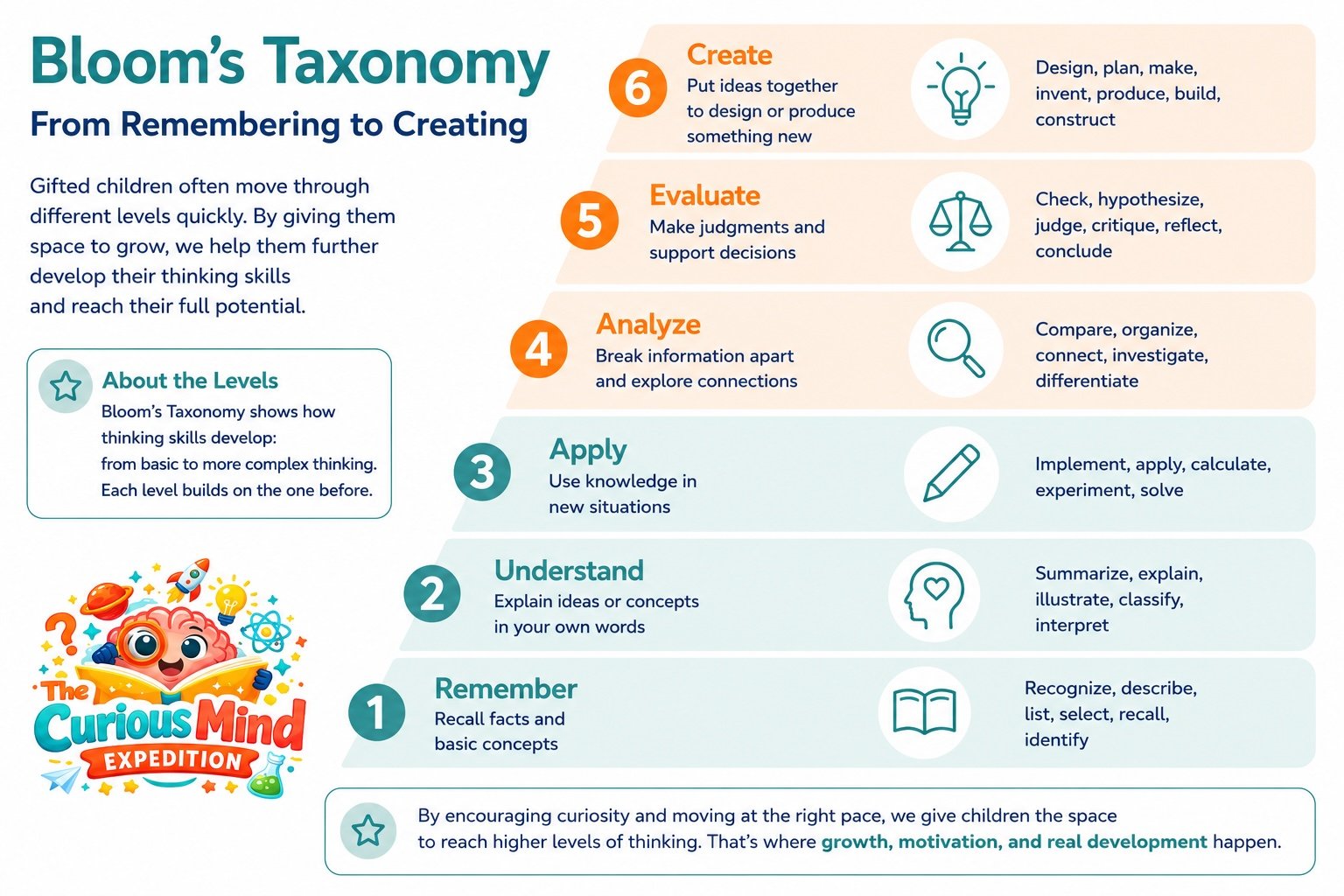
Bloom’s Taxonomy provides a useful framework for understanding why enrichment is so important, as illustrated in the model below.
In regular education, the focus is often on remembering, understanding, and applying knowledge. It is sometimes assumed that gifted children want to skip these foundational levels, but that is usually not the case. They also need knowledge and skills. The main difference lies in the order.
Although the taxonomy is often presented as a ladder, learning does not always have to follow a linear sequence. The different thinking skills can also be viewed as a toolbox. Depending on the challenge, different forms of thinking may be needed: remembering and understanding, but also applying, analyzing, evaluating, and creating.
For enrichment, this is a useful way to think about learning. A student does not always need to complete a series of simple tasks before engaging in complex thinking. A challenging research question, design task, or problem can provide a reason to seek new knowledge, make connections, evaluate information, and develop new ideas. In this way, the different thinking skills are not practiced in isolation, but used when they are needed within a meaningful challenge.
Research also supports the purposeful development of higher-order thinking skills in gifted education. A meta-analysis of interventions aimed at developing higher-order thinking skills found positive effects in areas including creative thinking, critical thinking, and problem-solving.⁴
Meaningful enrichment therefore responds not only to what a child already knows, but also to how a child thinks and uses different thinking skills.
Gifted children may have different learning goals
Providing appropriate education for gifted children is about more than knowledge.
Appropriate learning goals vary from student to student. For one learner, the challenge may lie primarily in deepening or broadening knowledge and developing more complex thinking skills. Another may benefit more from learning experiences that require planning, collaboration, perseverance, coping with mistakes, or reflection.
When curriculum compacting creates additional time, that time can be used purposefully to support different areas of development:
- Cognitive development: deepening and broadening knowledge and developing and applying complex thinking skills.
- Metacognitive development: learning to plan, choose strategies, monitor one’s own learning process, and reflect on it.
- Personal and social development: for example, collaborating, coping with challenge and frustration, and developing confidence in one’s own ability to learn.
Not every gifted student has the same learning goals in all of these areas. That is precisely why meaningful enrichment does not begin with the question, “What extra work can we give this student?” but with: “What does this student need to learn now?”
My lesson programs: enrichment with a purpose
This vision is the foundation of the educational programs I develop for gifted children.
These programs are not designed as extra work for students who finish quickly. They are designed to provide meaningful enrichment within the time created through curriculum compacting and can complement other forms of educational differentiation.
The programs combine:
- Depth enrichment
- Breadth enrichment
- Inquiry-based learning
- Bloom’s higher-order thinking skills
- Creative thinking
- Executive function skills
- Reflection and personal development
Children explore challenging questions, think critically, investigate new topics, and practice skills that are also important when learning becomes complex. In Brainexpedition, for example, students work toward conducting their own psychological research, while in MindMatters they use creative activities to explore thoughts, feelings, and behavior.
Not keeping children busy, but helping them grow
Gifted children deserve an education that matches both their abilities and their educational needs.
That begins by looking carefully at what a student has already mastered and which instruction and practice they still genuinely need.
By compacting where possible, accelerating where appropriate, and providing purposeful enrichment, education can better match what a student needs in order to keep learning.
Not more of the same, but an education that matches how gifted children learn, think, and develop.
Because gifted children don’t need more work. They need different work. The question should therefore not be:
“How do we keep this student busy?”
Instead, it should be:
“How do we make sure this student continues to learn?”
Scientific background
- Reis, S. M., Westberg, K. L., Kulikowich, J. M., & Purcell, J. H. (1998). Curriculum compacting and achievement test scores: What does the research say? Gifted Child Quarterly, 42(2), 123–129.
- Steenbergen-Hu, S., & Moon, S. M. (2011). The effects of acceleration on high-ability learners: A meta-analysis. Gifted Child Quarterly, 55(1), 39–53.
- Gül, M. D., & Ayık, Z. (2025). Impacts of enrichment programs on cognitive and affective skills of gifted students: A meta-analysis. PLOS ONE, 20(10), e0333714.
- Lo, C. O., & Feng, L.-C. (2020). Teaching higher order thinking skills to gifted students: A meta-analysis. Gifted Education International, 36(2), 196–217.
“Give gifted children different work, not more work”
Have you noticed that gifted children often move through the curriculum more quickly and need more than extra worksheets?
Download a free inquiry-based lesson that goes beyond traditional enrichment. Discover how to foster curiosity, critical thinking and ownership of learning. You’ll also receive occasional inspiration, practical teaching tips and new insights.





One Comment