
Why gifted children need to learn how to think, not what to think
The world has changed. Education is still catching up.
Schools were originally designed for a world where information was scarce, careers were relatively predictable and success depended on mastering established procedures. Students memorized facts, practiced routines and demonstrated what they knew by producing the correct answers.
That made perfect sense. When information was difficult to access, knowledge was a competitive advantage. The more you knew, the greater your opportunities. But today’s world looks very different from the one our education system was originally designed for. It will probably look even more different by the time today’s children enter the workforce.
Today, children carry more information in their pockets than previous generations had access to in a lifetime. At the same time, artificial intelligence is accelerating change at an unprecedented pace. AI can already generate articles, summarize information, generate images, create software code and explain complex topics in seconds. That raises an important question:
What should children learn when knowledge is available anytime, anywhere?
The answer is surprisingly simple: Children don’t just need to learn what to think. They need to learn how to think.
AI gives answers, but generally doesn’t ask good questions
Many people are amazed by what AI is already capable of, and rightly so. Artificial intelligence is transforming the way we learn, work, and solve problems. Their capabilities will only continue to improve. Yet AI still has one important limitation: it doesn’t think the way people do. It can generate remarkable answers, but the quality of those answers still depends largely on the quality of the questions we ask.
Consider these two questions/ prompts:
“Tell something about climate change.”
and
“How could climate change affect food production in the Netherlands over the next twenty years?”
The second prompt produces a much richer and more meaningful answer.
The difference isn’t AI. It’s the quality of the thinking behind the question. That’s why skills such as critical thinking, analysis, inquiry and asking thoughtful questions becoming more valuable than ever.
Tomorrow won’t belong to the people who simply know the most facts. It will belong to those who know how to ask the right questions.
What will tomorrow’s children need?
The job market is changing rapidly. Artificial intelligence and automation are transforming existing professions while creating entirely new ones. In fact, many of the jobs today’s children will have don’t even exist yet. As a result, the value of knowledge itself is changing.
Increasingly, employers are looking for people who can:
- think critically;
- develop creative solutions;
- analyse and solve complex problems;
- evaluate information;
- recognize patterns and relationships across subjects;
- collaborate effectively;
- adapt to change.
These are often called 21st-century skills, but at their core they all come down to one thing: the ability to think, learn, and adapt in a rapidly changing world.
Why memorizing answers is no longer enough
Foundational knowledge still matters! Children can’t ask meaningful questions about subjects they know nothing about and they can’t connect ideas without a basic understanding. But knowledge is no longer the end goal of education. It is the starting point.
Its real value lies in what children do with it. Knowledge becomes powerful when children use it to:
- recognize meaningful connections;
- evaluate arguments;
- critically evaluate information;
- develop new ideas;
- solve problems;
- come up with creative solutions.
In other words: when they learn how to think.
Many gifted children already think this way
Many gifted children are naturally curious. They don’t just want to know that something is true, they want to understand why. They ask questions that go deeper and further than most people ever think to ask. That kind of inquiry is one of their greatest strengths. Yet today’s education system doesn’t always know how to nurture it.
Although education has changed in many ways, classrooms still often emphasize finding the correct answer. Yet gifted children thrive when they are encouraged to ask questions, investigate ideas, make connections and explore different perspectives. (Read more about this in this article.)
Their strength isn’t just what they know. It’s how they think.
Learning to think is a skill you can develop
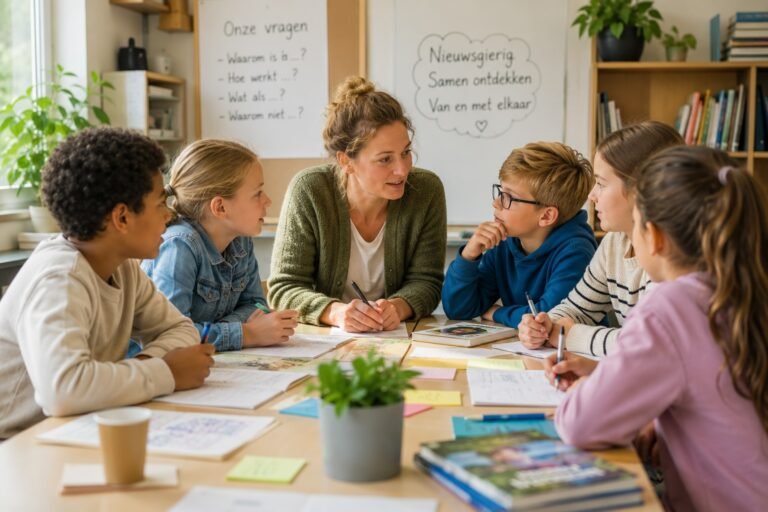
Strong thinking skills don’t develop automatically. Like reading, writing, or mathematics, learning how to think takes practice. Children become better thinkers when they are challenged to analyze problems, develop meaningful research questions, compare different creative solutions, weigh evidence, and reflect on their own thinking.
That doesn’t happen by giving children more worksheets. It happens by giving children opportunities to stay curious.
What does this mean for gifted children?
Many gifted children master foundational knowledge quickly. That gives them something incredibly valuable: time and space to explore, create, ask questions, make mistakes and develop higher-order thinking skills.
Those are precisely the abilities that will help them succeed in a world where information is always available and technology increasingly takes over routine tasks.
Education for the future
Tomorrow’s world doesn’t need children who can simply memorize every answer. It needs children who stay curious. Children who aren’t afraid to question. Children who critically evaluate information. Children who recognize new possibilities. And children who continue learning even when the answers are only a click away.
Because in a world where AI keeps getting better at providing answers, one human skill becomes more valuable than ever:
The ability to ask better questions!
Perhaps that’s the most important reason why we need to teach children how to think.
The world is changing! Let’s teach children how to think.
In a world where AI can generate answers in seconds, the ability to ask thoughtful questions, think critically, and solve problems creatively has never been more important.
Help children develop curiosity, inquiry skills, and confident problem-solving with a free lesson from The Curious Mind Expedition. You’ll also receive occasional inspiration, practical teaching ideas, and new insights into gifted education.