
Gifted children don’t need more work. They need different work.
Why more of the same doesn’t lead to greater development
When a gifted child finishes classroom work before the rest of the class, teachers often look for a practical solution. That’s completely understandable. Teachers are responsible for an entire class and also need to make time for students who require additional instruction or support.
As a result, students who finish early are often given an extra worksheet, a more difficult math problem, or a separate puzzle book. This keeps them occupied while the rest of the class continues working. But being busy is not the same as learning.
Many gifted children don’t need more work. Additional practice of material they have already mastered rarely leads to new learning. Assignments without a clear learning goal seldom increase motivation. Instead, they often lead to boredom, frustration and the feeling that working quickly is being punished.
Gifted children often learn more quickly
Many gifted children need less instruction and less repetition to master new material. They recognize patterns quickly, make connections easily and often understand a new concept after only a few examples.
That doesn’t mean everything comes naturally to them. Gifted children also need to acquire new knowledge and develop new skills. The difference lies mainly in the pace at which they master new learning.
When a student has already achieved the learning objectives, additional practice provides little educational benefit. Yet the extra time is often filled with more of the same: extra math problems, additional language exercises or separate classroom activities simply to keep students occupied. This means an important opportunity is being missed.
Curriculum compacting: creating room for growth
An important strategy in gifted education is curriculum compacting.
With curriculum compacting, unnecessary repetition is removed while the essential learning objectives remain in place. A student demonstrates mastery of the material and no longer needs to complete every practice exercise.
Curriculum compacting is not a way of learning less. It is a way of creating time for new challenges. When gifted children no longer have to spend their time on endless repetition, space is created for enrichment, differentiated instruction and other learning experiences that better match their educational needs.
Acceleration when it’s needed
In some cases, curriculum compacting alone is not enough.
A student may not only master the curriculum more quickly but may also be ready for material from a higher grade level. In these situations, acceleration can be an appropriate educational strategy.
Acceleration can take different forms. It may involve studying a subject at a higher grade level, moving through the curriculum at a faster pace or in some cases even skipping an entire grade.
The goal of acceleration is not to move a child through school as quickly as possible. The goal is to provide an education that matches the level at which a student learns and thinks. Acceleration is always individualized, taking into account factors such as social development and the opportunities available within the school before making a final decision.
Enrichment: where real growth happens
Curriculum compacting creates time. Acceleration and/or enrichment then determine how that time is used.
Effective enrichment goes beyond simply giving more difficult assignments. It involves different ways of thinking, investigating, creating, and learning. Within gifted education, a distinction is often made between depth enrichment and breadth enrichment.
Depth enrichment
With depth enrichment, students explore a topic in greater depth. The focus is on critical thinking, analyzing, investigating, and making complex connections. This might in example include formulating research questions, exploring philosophical questions or solving complex problems.
Breadth enrichment
With breadth enrichment, students explore new areas of knowledge beyond the regular curriculum. Alongside their regular schoolwork, they may learn about history, science and technology, global citizenship, an additional language, or arts and culture.
This creates opportunities for curiosity, talent development and discovering new interests.
Enrichment is more than cognitive challenge
When people think about enrichment, they often think of more difficult assignments or additional curriculum content. But for gifted children, enrichment is about much more than that.
Effective enrichment not only challenges thinking, but also supports the development of the skills that gifted children often need in order to grow. These include planning, working together, learning from mistakes, persevering when something doesn’t come easily and reflecting on their own learning process.
As a result, enrichment contributes not only to what a child learns, but also to how a child learns and who a child becomes.
Enrichment and Bloom’s Taxonomy
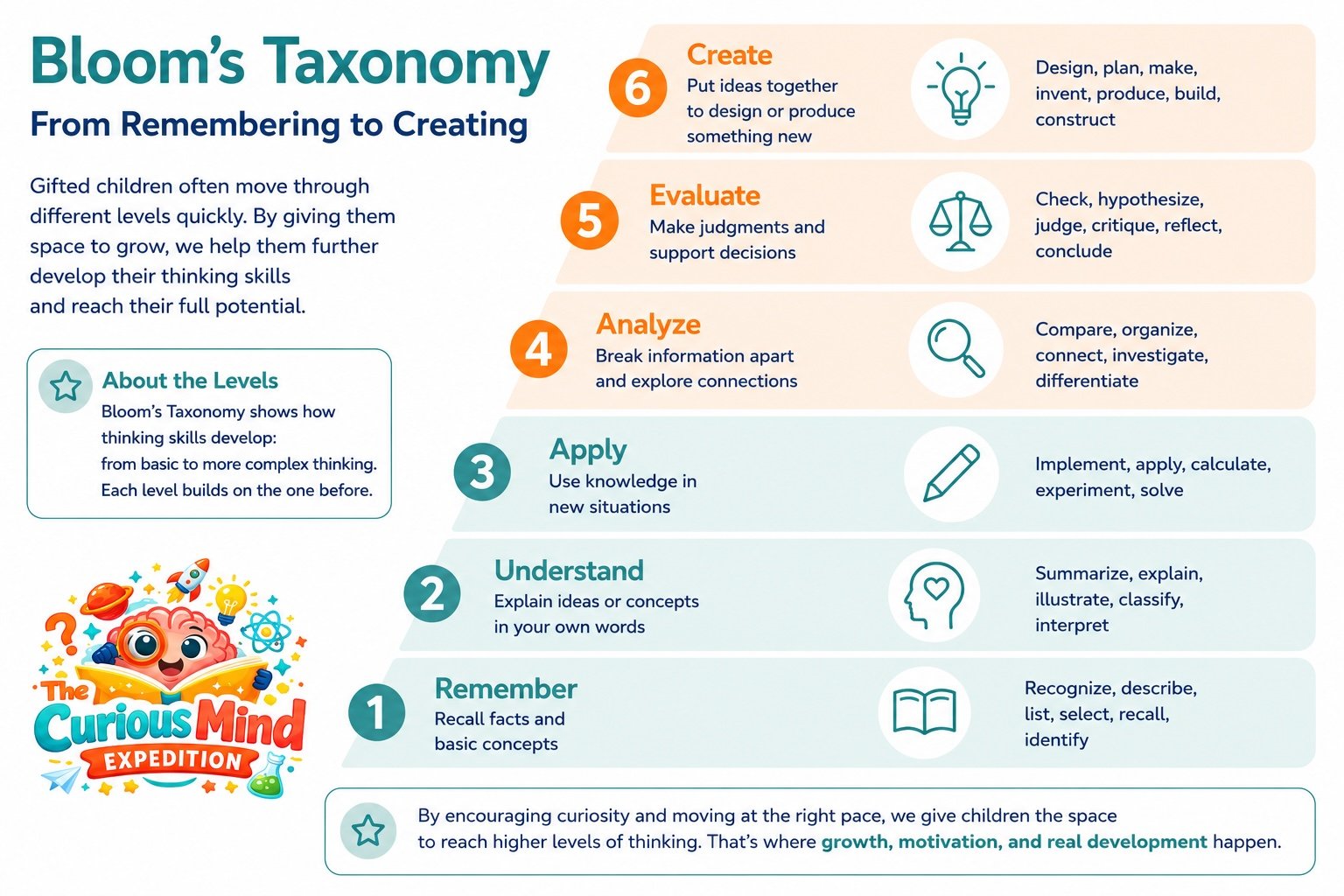
Bloom’s Taxonomy provides a useful framework for understanding why enrichment is so important, as illustrated in the model below.
In regular education, the focus is often on remembering, understanding, and applying knowledge. It is sometimes assumed that gifted children want to skip these foundational levels, but that is usually not the case. They also need knowledge and skills. The main difference lies in the order.
Many gifted children move naturally between different thinking skills from an early age. While they are acquiring new knowledge, they are often already analyzing, making connections, evaluating and creating. For them, Bloom’s Taxonomy often resembles a toolbox rather than a ladder. Depending on the challenge, they choose the thinking tool they need at that moment. Sometimes they begin by creating, sometimes by analyzing and sometimes by evaluating. They acquire any missing knowledge along the way.
It is precisely this ability to move between different levels of thinking that provides many gifted children with the challenge they are looking for. They want to explore connections, compare ideas, design solutions, weigh arguments and develop new concepts. When they discover they are missing information, they use the foundational levels to acquire that knowledge. This is a key factor in fostering motivation, ownership of learning and deep learning in gifted children.
Appropriate enrichment therefore aligns not only with what a child knows, but above all with how a child thinks.
Gifted children often have different learning goals
Providing appropriate education for gifted children is about more than knowledge.
Because their development often follows a different path, many gifted students have learning goals beyond cognitive challenge. These may include perseverance, learning from mistakes, planning and organization, collaboration, self-reflection and social-emotional development.
When time is created through curriculum compacting, there is an opportunity to work on these different areas of development.
For me, enrichment goes beyond cognitive challenge alone. Of course, it is important that gifted children are challenged to analyze, evaluate, create, and investigate. But it is just as important that they learn how to learn and develop the skills that help them deal with challenges.
Effective enrichment therefore contributes to three areas of development:
- Cognitive development: deepening and broadening knowledge while developing higher-order thinking skills.
- Metacognitive development: learning to plan, organize, reflect and take responsibility for one’s own learning process.
- Social-emotional development: developing perseverance, self-confidence, collaboration and learning to cope with mistakes and frustration.
It is the combination of these three areas that helps gifted children grow not only in what they know, but also in how they learn and who they become.
My educational programs: enrichment with a purpose
This vision is the foundation of the educational programs I develop for gifted children.
These programs are not intended as extra work for students who finish early. They are designed as meaningful enrichment within the time created through curriculum compacting and can complement other forms of personalized learning.
The programs combine:
- Depth enrichment
- Breadth enrichment
- Inquiry-based learning
- Bloom’s higher-order thinking skills
- Creative thinking
- Executive function skills
- Reflection and personal development
Children work on challenging questions, learn to think critically, investigate new topics and develop the skills they need to become successful and resilient in life. In Brainexpedition, they work toward conducting psychological research. In MindMatters, they explore thoughts, feelings, and behavior through creative learning activities.
Not keeping children busy, but helping them grow
Gifted children deserve an education that matches both their abilities and their educational needs.
That begins with recognizing that many gifted children have different learning goals than other children their age.
By using curriculum compacting where possible, acceleration where appropriate, and enrichment whenever it adds value, an education can provided that truly supports growth.
Not more of the same, but an education that matches how gifted children learn, think, and develop.
Because gifted children don’t need more work. They need different work. The question should therefore not be:
“How do we keep this student busy?”
Instead, it should be:
“How do we make sure this student continues to learn?”
“Give gifted children different work, not more work”
Have you noticed that gifted children often move through the curriculum more quickly and need more than extra worksheets?
Download a free inquiry-based lesson that goes beyond traditional enrichment. Discover how to foster curiosity, critical thinking and ownership of learning. You’ll also receive occasional inspiration, practical teaching tips and new insights.