
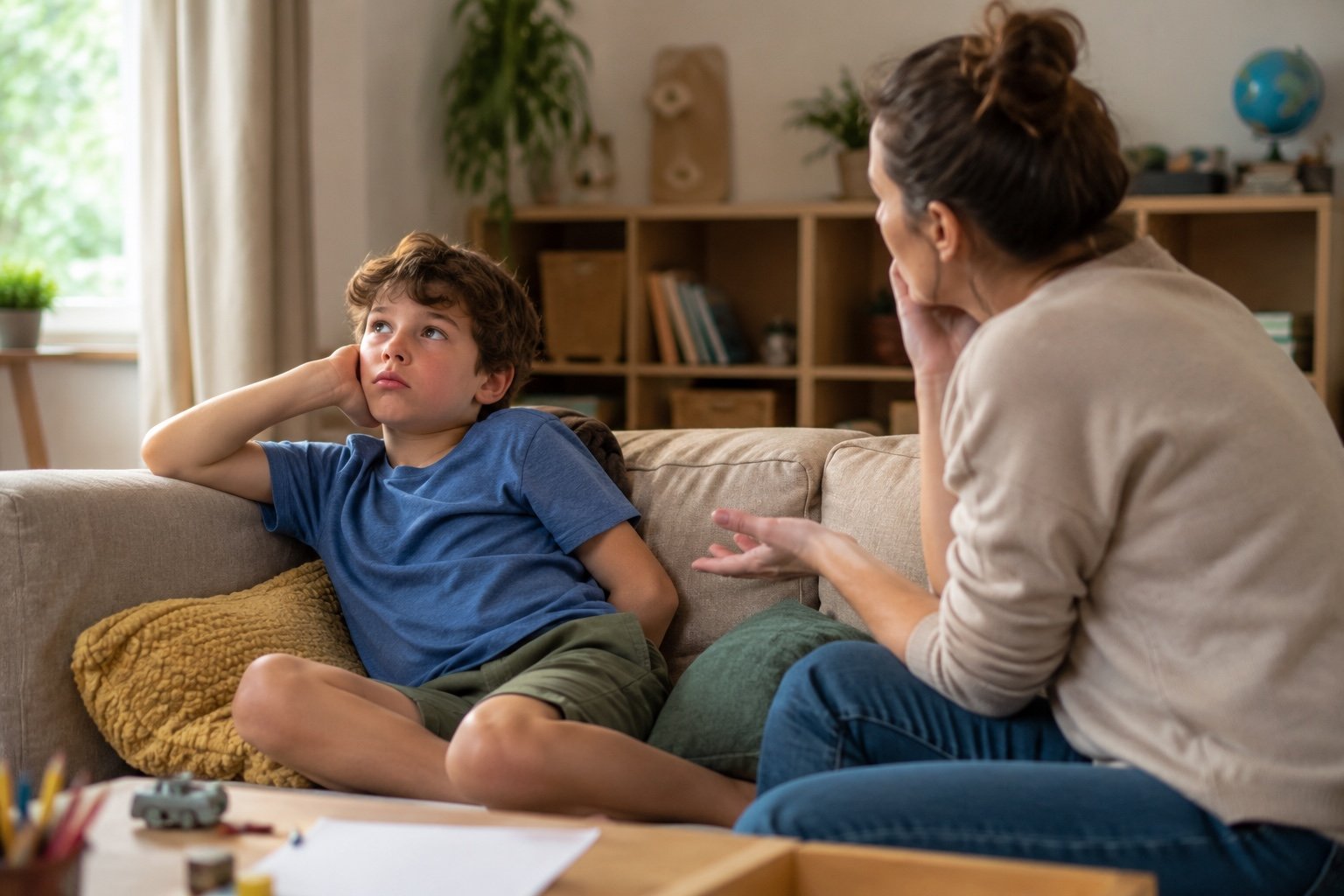
Why it’s perfectly okay if your gifted child gets bored during summer break
“Mom, I’m bored.”
Most parents have heard these words at some point. And the response is often immediate: How can I keep my child entertained? A quick online search brings up endless lists of summer activities, creative crafts, educational games, and enrichment ideas. As if boredom is something that needs to be fixed as quickly as possible.
But what if we’re asking the wrong question? Instead of wondering how to keep our children constantly occupied, perhaps we should first ask what they really mean when they say, “I’m bored.” For many gifted children, boredom isn’t simply about having nothing to do. It can be a sign that something much deeper is happening.
Summer break is often a time for recovery
For many gifted children, summer break is about much more than having a few weeks off school. It can be a much-needed opportunity to recover from the demands of the school year. A typical school day involves far more than learning new information. Children are expected to follow instructions, switch between subjects, stay focused, follow classroom rules, work at the pace of the group, and navigate a constant stream of social interactions. For gifted children, there are often additional challenges. They may spend large parts of the day waiting for classmates to catch up, trying not to stand out, masking their abilities, or coping with chronic under-stimulation. Even when they appear relaxed on the outside, these experiences require considerable mental energy.
Research shows that prolonged cognitive effort and continuous self-regulation place significant demands on the brain. Recovery periods are essential for restoring attention, motivation, and mental energy. Although little research has specifically examined gifted children during summer break, these findings align closely with what many parents observe: some gifted children seem to do very little during the first weeks of the holidays. Perhaps this isn’t a lack of motivation. Perhaps their brains are simply recovering.
Just as adults often need time to decompress after an intense period at work, children may also need time before their natural curiosity begins to return. Rather than rushing to fill every quiet moment, giving them space to rest may be exactly what they need.
“I’m bored” doesn’t always mean the same thing
When a child says they’re bored, it’s easy to assume there simply isn’t enough to do. In reality, boredom isn’t a single experience. The very same words can reflect very different underlying needs. Understanding what lies beneath “I’m bored” is often far more valuable than immediately trying to solve it.
A mind full of ideas, but no idea where to start
Many gifted children don’t lack ideas. In fact, they often have far too many. They want to build a treehouse, write a novel, create a stop-motion movie, learn a programming language, design an insect hotel, or invent something completely new. But which idea should they choose? Where do they begin? And how do they turn one big idea into a manageable first step? That requires executive functioning skills. The mental processes that help us plan, organise, make decisions, prioritise, and get started. These skills continue to develop throughout childhood and adolescence, even in children whose intellectual abilities are far ahead of their peers. Read more about executive functioning skills in this blog.
Being highly intelligent doesn’t automatically make planning easier. Sometimes a gifted child isn’t short of ideas at all. Instead, they’re overwhelmed by possibilities and unsure how to turn those ideas into action.
Learning to take charge again
There’s another kind of boredom that I recognise in my own family. During the school year, almost every hour of a child’s day is planned for them. Adults decide where they should be, what they should do, when to start, and when to stop. Then summer break arrives, and suddenly that structure disappears. And with it comes perhaps the hardest question of the day:
“What do I actually feel like doing?”
It sounds simple. But for many children, it isn’t. When your days are structured by others for months on end, you can lose the habit of deciding for yourself how to spend your time. Some children aren’t even sure anymore what they genuinely enjoy doing. I’ve noticed this with my own children. When they don’t know what they want to do, they’re quick to reach for a screen. Not necessarily because they want to play games or watch videos. But because a screen makes the decisions for them. There’s always another video, another game, another recommendation waiting. They don’t have to think about what they want to do next. That’s exactly why screens can become so appealing during moments of boredom. Not because children are lazy. But because a screen instantly fills the empty space.
Perhaps boredom is where curiosity begins
As parents, our instinct is to help. We suggest an activity. We offer ideas. We fill the afternoon with something fun. That’s completely understandable. But perhaps we’re solving something that isn’t actually a problem.
Researchers increasingly view boredom not simply as an unpleasant feeling, but as a signal that we’re searching for something more meaningful. When external stimulation temporarily fades away, the brain has an opportunity to wander, process experiences, and make new connections. These mental processes are closely linked to creative thinking. This doesn’t mean that boredom automatically makes children more creative. Rather, creativity often emerges after we’ve had enough uninterrupted time to pause, reflect, and step away from a constant stream of stimulation. Perhaps that’s exactly what makes summer break so valuable. Not because children are busy every minute of the day. But because they finally have the time and space to rediscover what genuinely sparks their curiosity from within.
How can you respond when your gifted child says they’re bored?
Perhaps the answer isn’t finding another activity. Perhaps it starts with asking a different question.
Does my child simply need time to recover?
After an intense school year, doing absolutely nothing may be exactly what your child needs. For both parents and children, this can feel surprisingly uncomfortable at first. Watching your child wander around the house, seemingly doing very little, can easily make you wonder whether you should step in. But sometimes, this quiet period is exactly what allows children to slow down, recharge, and eventually rediscover their own initiative.
Is my child overwhelmed by too many ideas?
If that’s the case, resist the urge to choose an activity for them. Instead, help them take the first small step. Many gifted children benefit from making their ideas visible. Writing them down, sketching them, or creating a simple mind map can make a long list of exciting possibilities feel much more manageable. Once everything is out of their head and onto paper, choosing one idea often becomes much easier. If needed, help your child break that idea down into a single, achievable first step.
Or has my child forgotten how to shape a free day?
Instead of offering solutions, try asking questions.
Is there something you’ve always wanted to learn?
What would you like to discover today?
What do you need to get started?
Questions like these encourage children to reconnect with their own interests and gradually take ownership of their free time again. That may be far more valuable than a summer filled with organised activities.
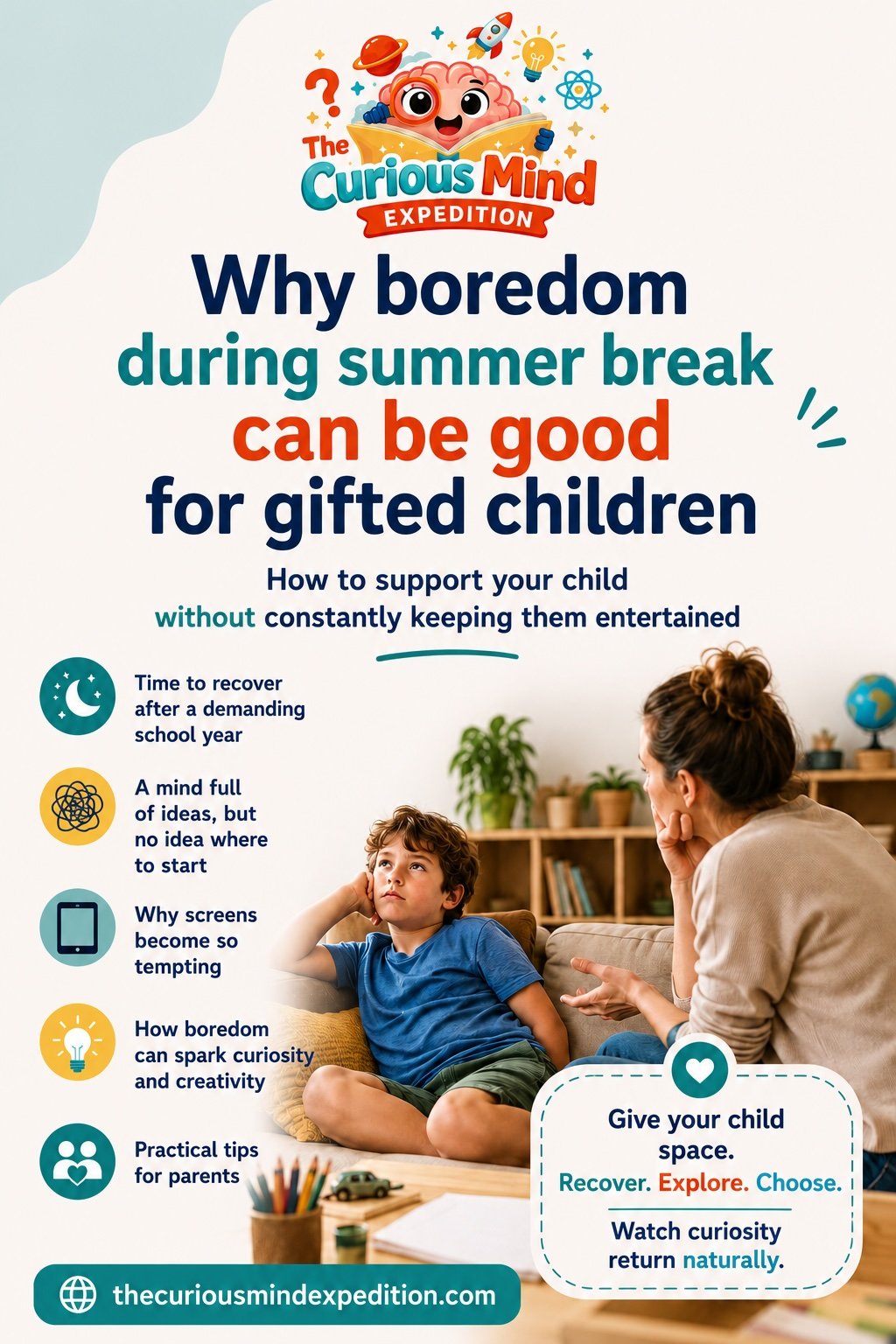
The return of curiosity
At The Curious Mind Expedition, we believe that curiosity is the driving force behind learning. But curiosity can’t be scheduled. It doesn’t appear because an adult comes up with another activity or fills the calendar with even more plans. Curiosity needs space. Space to recover. Space to daydream. Space to pause. Space to not know what to do for a while. And yes—space to be bored.
Perhaps we don’t need to entertain our children every moment of the day. Perhaps we can trust that beneath what looks like boredom, something meaningful is quietly taking shape. Curiosity can’t be forced. Sometimes it only returns after children have had enough time to recover, experience boredom, and rediscover for themselves what genuinely excites them. And perhaps that’s one of the greatest gifts summer break can offer.
Want to learn more about nurturing curiosity? Read our blog on practical ways to encourage curiosity in gifted children.
References
- Diamond, A. (2013). Executive Functions. Annual Review of Psychology, 64, 135–168.
- Diamond, A., & Ling, D. (2016). Conclusions about interventions shown to aid executive function development in children.
- Smallwood, J., & Schooler, J. W. (2015). The Science of Mind Wandering. Annual Review of Psychology, 66, 487–518.
- Westgate, E. C., & Wilson, T. D. (2018). Boring Thoughts and Bored Minds. Perspectives on Psychological Science, 13(6), 689–706.
- Said-Metwaly, S., et al. (2023). Executive functions and creativity in children: A systematic review.

Ready to spark curiosity?
Wondering how to encourage curiosity without planning every minute of summer break? Download our free lesson. One surprising question or mind-bending optical illusion can be enough to ignite a child’s curiosity and start a new journey of discovery. Along the way, you’ll receive occasional inspiration, practical teaching ideas, and evidence-informed insights into gifted education, curiosity, and learning.