How to encourage curious thinking? 10 practical tips for home and the classroom
Why curiosity may be the most important skill for the future
Why?….
It may be the most important word a child can learn to use. Young children ask hundreds of questions every day. Why is the sky blue? Why can birds fly? Their curiosity seems endless. They want to understand how the world works and eagerly explore it with an open mind. But somewhere along the way, many children gradually lose that natural curiosity. That’s unfortunate, because curiosity is the foundation of deep learning, creativity, and personal growth. In a world where information is available instantly and artificial intelligence is becoming increasingly capable of providing answers, the ability to stay curious may be more valuable than ever.
In an earlier blog, I explained why children need to learn how to think rather than simply memorize answers. But how can we help children stay curious? And why is curiosity especially important for gifted children?
Curiosity is the driving force behind motivation
Many people see curiosity as a nice personality trait. Something some children simply have more of than others. But curiosity is much more than that.
Curiosity is the driving force behind learning. When children are genuinely curious about something, they want to understand it. They ask questions, see connections between ideas and search for answers on their own. As they do, they don’t just gain knowledge, they also develop critical thinking skills, creativity, and self-reflection.
Why curiosity is especially important for gifted children
Many gifted children aren’t motivated by difficult work. They’re motivated by meaningful work. They want to understand how things work, discover connections, and investigate new questions of their own. That natural curiosity is one of their greatest sources of motivation.
When learning becomes mainly about reproducing knowledge or earning high grades, some children lose the very thing that motivates them most: the freedom to be curious. This can lead to underachievement, boredom, or even the belief that learning is boring. Not because these children don’t want to learn, but because they have too few opportunities to follow their natural curiosity. That’s exactly why encouraging curiosity is so important.
Curiosity helps children understand themselves and others
Curiosity is often associated with science, technology or subjects in school. But perhaps the most important kind of curiosity is curiosity about yourself and about other people. Children who are willing to look at themselves with curiosity ask questions such as:
- Why did I react so angrily?
- Why does this make me feel so nervous?
- Why is it easy to work with one person but difficult with another?
- Why does my classmate see this so differently?
Questions like these form the foundation of social-emotional development. Children learn to better understand their own thoughts, emotions, and behavior. They develop empathy by becoming curious about other people’s experiences and discover that there is often more than one way to look at a situation. As a result, they grow not only in self-awareness but also in understanding of the people around them.
For curiosity to flourish, children first need to feel safe. They only dare to ask questions, share their ideas, or make mistakes when they know they will be taken seriously. That’s why a curious classroom doesn’t begin with a challenging activity. It begins with a learning environment where wonder, different perspectives, and mistakes are welcomed.
At the same time, the relationship works both ways. Curiosity also helps create a greater sense of psychological safety. Children who learn to approach themselves and others with openness and curiosity are less likely to judge. They become comfortable with different perspectives and discover that there isn’t always one right answer. As a result, they find it easier to accept mistakes, ask questions and learn from one another.
Curiosity is much more than a cognitive skill. It’s a way of looking at the world and at yourself. A mindset that not only supports learning, but also strengthens resilience, self-confidence, empathy, and healthy relationships.
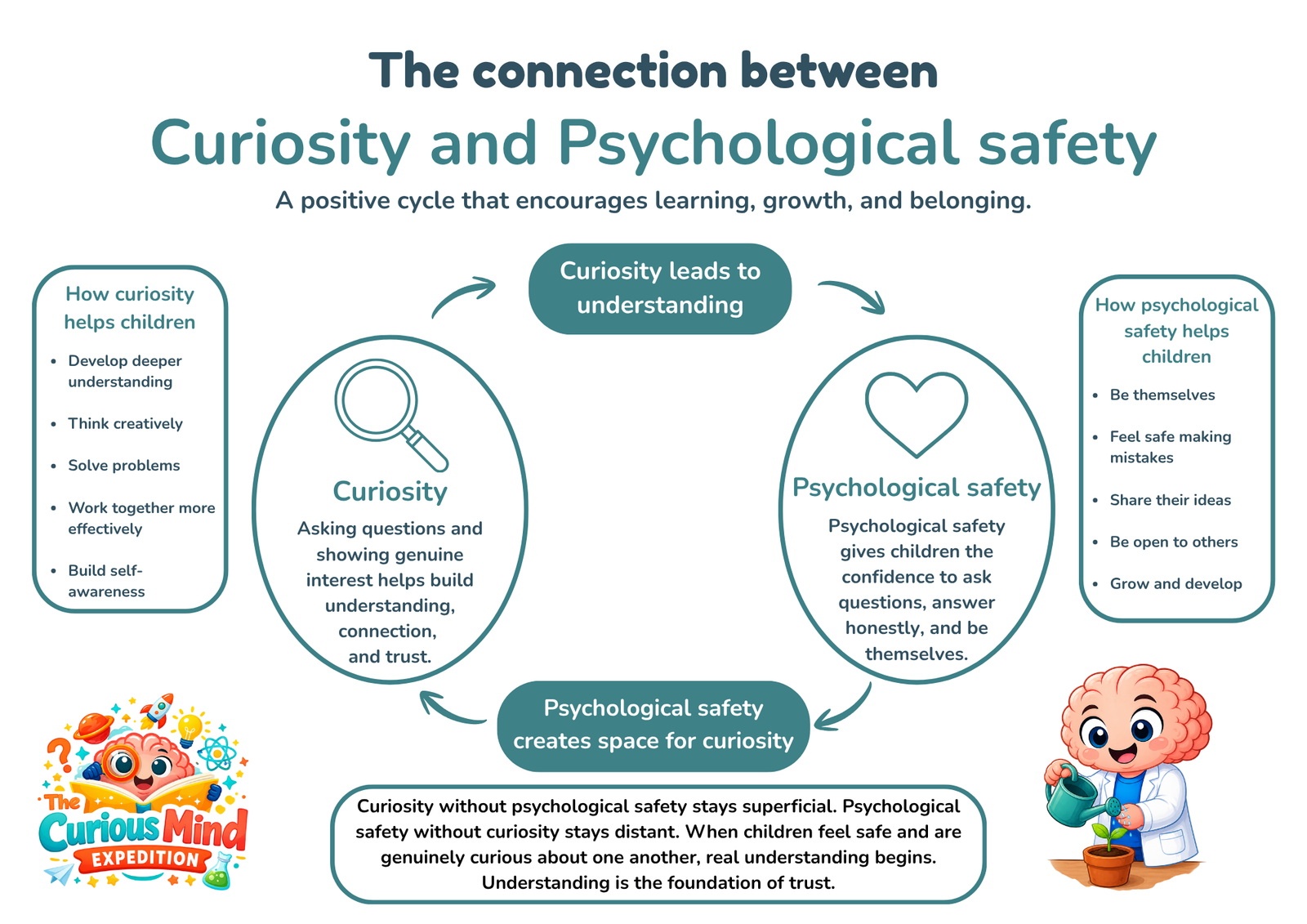
Figure 1. Curiosity and psychological safety reinforce one another. A psychologically safe environment gives children the confidence to ask questions and make mistakes. In return, a curious and open mindset helps children appreciate different perspectives, better understand themselves, and learn together with greater confidence.
Can you encourage curiosity?
Absolutely!
Although some children seem naturally more curious than others, the environment plays a major role. Parents and teachers can strengthen curiosity every day, or unintentionally discourage it. The good news is that this doesn’t require expensive materials or elaborate lesson plans. Small changes in the way you ask questions, respond to children, or present activities can make a remarkable difference.
Here are ten practical ways to encourage curiosity in children.
1. Don’t give the answer right away
When a child asks a question, our first instinct is often to give the answer. Instead, try asking questions like:
- What do you think?
- How could we find out?
- What possibilities do you see?
Why does this work?
By resisting the urge to answer immediately, you invite children to think for themselves. They learn to weigh different possibilities, make connections and explain their reasoning. Without realizing it, they are strengthening important executive functions such as problem-solving, cognitive flexibility and metacognition: thinking about their own thinking. At the same time, their confidence grows as they discover they can figure out far more than they initially believed.
2. Praise thoughtful questions
In many situations, children are praised for giving the correct answer. Try praising an insightful or thought-provoking question instead. For example:
“That’s a really interesting question. I hadn’t thought about it that way before.”
Why does this work?
When children notice that curiosity is valued, they become more willing to ask questions. They learn that learning isn’t about always having the right answer, but about having the courage to explore what they don’t know yet. This strengthens their initiative, self-reflection, and intrinsic motivation. That motivation is exactly what helps children continue learning when things become challenging.
3. Encourage children to make predictions
Before explaining something, ask questions like:
- What do you think is going to happen?
- Why do you think that?
- How could we investigate that?
Why does this work?
By making predictions children will activate prior knowledge. They begin making connections, forming hypotheses, and later comparing their expectations with what actually happens. This helps new knowledge stick more effectively. At the same time, they strengthen their working memory and learn to evaluate their own ideas critically.
4. Let children see that you don’t know everything
Many adults feel they should always have the answer. But sometimes it’s far more powerful, and honest, to say:
“I actually don’t know. Shall we find out together?”
Why does this work?
Children learn that learning never really ends and that no one has to know everything. This reduces the pressure to be perfect while helping them become more comfortable with uncertainty. They also develop a growth mindset: you don’t have to be able to do something yet, as long as you’re willing to keep learning.
5. Ask open-ended questions
Open-ended questions can’t be answered with a simple yes, no, or single correct answer. They invite children to think more deeply. For example:
- Why do you think that?
- How do you know?
- What other solution might be possible?
- What do you think would happen if…?
Why does this work?
Open-ended questions encourage children to explore different perspectives. They learn to look beyond the first answer that comes to mind and discover that complex questions often have more than one good answer. In doing so, they strengthen their cognitive flexibility and become more aware of their own reasoning.
6. Make room for wonder
Not every activity needs to have an immediate learning objective. Sometimes it’s enough to spend a few minutes together looking at an unusual cloud, an insect, a work of art or the night sky.
Why does this work?
Curiosity often begins with wonder, and wonder grows in moments of calm. Especially when children have time to slow down, or even experience boredom, their creativity has room to emerge. By taking time to notice something that fascinates them, they naturally become eager to explore further. In this way, children learn to sustain their attention for longer and discover that something doesn’t have to be immediately useful to be worthwhile. The best questions often begin with a sense of wonder.
7. Let children experiment
Let children discover what works for themselves. For example:
- Which bridge is the strongest?
- Which paper airplane flies the farthest?
- Which materials float?
Why does this work?
By experimenting, children discover that learning is an active process. They make plans, test ideas, discover what doesn’t work and adjust their approach. In doing so, they develop perseverance and learn to adapt when things don’t go as expected. These are skills they will benefit from for the rest of their lives.
8. Ask for a second solution
When a child has found a solution, ask:
“Can you think of another solution?”
Or:
“Which solution would surprise you the most?”
Why does this work?
Many children stop thinking as soon as they find one answer. By encouraging them to keep exploring, they discover that there is often more than one possible solution. This helps them think more creatively and prevents them from getting stuck on their first idea.
9. Make mistakes valuable
When something doesn’t work, don’t ask:
“Why did you do that?”
Questions that begin with ‘why’ can sometimes sound judgmental. Instead, try questions that begin with how, what, who, or where. Such as:
- How did you figure that out?
- What didn’t work?
- What would you do differently next time?
Why does this work?
Children who see mistakes as opportunities to learn are more willing to take on new challenges. They become more resilient and learn to evaluate their own approach critically. As a result, they develop not only greater perseverance but also greater confidence. They begin to see mistakes not as failure, but as an essential part of the learning process.
10. Give children real-world problems
Work on questions that even adults don’t immediately know the answer to. For example:
- How can we make our school more sustainable?
- How can we make sure everyone feels welcome in the classroom?
- How would you design the perfect playground?
Why does this work?
Real-world problems feel meaningful. Children see that their ideas matter, which increases their intrinsic motivation to search for solutions. As they investigate, they plan their approach, divide tasks, evaluate ideas and collaborate with others. In the process, they develop not only knowledge, but also the executive functioning skills they need to work independently and purposefully.
Curiosity is not the goal. It’s a way of thinking.
Children who stay curious don’t just learn more. They also develop the confidence to embrace new challenges, think critically and better understand themselves.
Perhaps curiosity is one of the most valuable gifts we can give children. Not because it leads to better grades, but because it lays the foundation for lifelong learning and personal growth.
Curious thinking can be developed
Many people think curiosity is a personality trait: you either have it or you don’t. Fortunately, that’s not true. Curiosity is like a muscle. The more children are encouraged to ask questions, make connections, and explore for themselves, the stronger their curious mindset becomes.
At The Curious Mind Expedition, we believe education is about more than transferring knowledge. Knowledge matters, of course, but it is just as important that children learn how to think, collaborate and understand themselves.
That’s exactly why I create learning resources that combine curiosity with social-emotional learning. Children don’t just discover how the world works, they also learn how their own thoughts, emotions and behavior influence the choices they make. Through philosophical discussions, creative challenges, psychological insights, and thought-provoking activities, they learn to ask meaningful questions, reflect on their thinking, and stay open to new ideas. Along the way, they strengthen their executive functioning skills while also building confidence, resilience, empathy, and a sense of ownership over their own learning.
In the end, our goal isn’t for children to remember our answers. We want them to keep asking their own questions.
Curiosity starts with one good question!
Curiosity is the driving force behind learning. Download a free lesson from The Curious Mind Expedition and discover how children can learn to investigate, think deeply and ask meaningful questions. They’ll experience that the best discoveries often begin with a single great question. You’ll also receive occasional inspiration, practical teaching tips, and new insights.